California Freight Cleanup → Investigation M-4
Which uncertainty deserves the next research dollar?
Effectiveness_scale: $7.65B adjusted EVSI at $3.0M cost (ROI 2,551×)Investigation 3-10’s 6-D Saltelli decomposition found that effectiveness_scale (ST 39%) and VSL (ST 27%) both outrank βPM2.5 (ST 15%) as drivers of cascade net-benefit variance. Investigation M-4 synthesizes those Sobol indices with the Investigation 6-5 CRF EVSI anchor to produce a ranked research-budget priority memo covering all four top drivers.
The decision
An earlier investigation (Investigation 6-5) recommended a $7.5M research pathway to tighten the PM2.5 health-risk coefficient, citing roughly $4.87B in expected decision value (ROI 1,519×). That recommendation was built when the health-risk coefficient was understood to be the primary cascade uncertainty driver. The cascade-wide sensitivity analysis (Investigation 3-10) changed the picture: how well programs actually work in the field (effectiveness, 39% of variance) and the value we place on a statistical life (VSL, 27%) both rank above the health-risk coefficient (15%).
Is the original CRF research priority still the right allocation for the next $5M? Or should it go primarily toward reducing program effectiveness uncertainty and VSL uncertainty? Investigation M-4 answers this using the sensitivity indices as allocation weights.
Methodology
Proportional EVSI scaling anchored to the Investigation 6-5 CRF result. The only fully-worked EVSI calculation in the California Freight Cleanup cascade is Investigation 6-5’s βPM2.5 roadmap. Investigation M-4 uses that result as the scaling reference:
raw_evsi(driver) = inv24_l3_evsi_b × (ST(driver) / ST(βPM2.5))
adjusted_evsi(driver) = raw_evsi(driver) × reducibility(driver)
Where reducibility is the analyst-specified fraction of variance that research could realistically eliminate (not all variance is resolvable by feasible study designs). The βPM2.5 reducibility of 78% is sourced directly from Investigation 6-5’s staged pathway (50% sigma reduction = 75% variance reduction). The other reducibilities (effectiveness_scale 60%, emissions_scale 50%, VSL 25%) are analyst judgments calibrated to study-design literature and CARB program knowledge.
Research priority ranking
| Rank | Driver | Investigation 3-10 ST share | Adjusted EVSI ($B) | Research cost ($M) | ROI |
|---|---|---|---|---|---|
| 1 | effectiveness_scale | 39.4% | $7.65 | $3.0 | 2,551× |
| 2 | βPM2.5 (CRF) | 15.1% | $3.80 | $2.5 | 1,519× |
| 3 | emissions_scale | 18.1% | $2.93 | $1.5 | 1,953× |
| 4 | VSL | 27.4% | $2.21 | $0.5 | 4,424× (partly governance) |
Note on VSL ranking: VSL has the highest raw ROI (4,419×) but low reducibility (25%) because the wide $5M–$20M envelope is partly an institutional choice, not a scientific gap. Adopting the EPA OAQPS guidance band narrows spread by ~50% at near-zero research cost. The research component alone yields ~25% reduction.
Findings
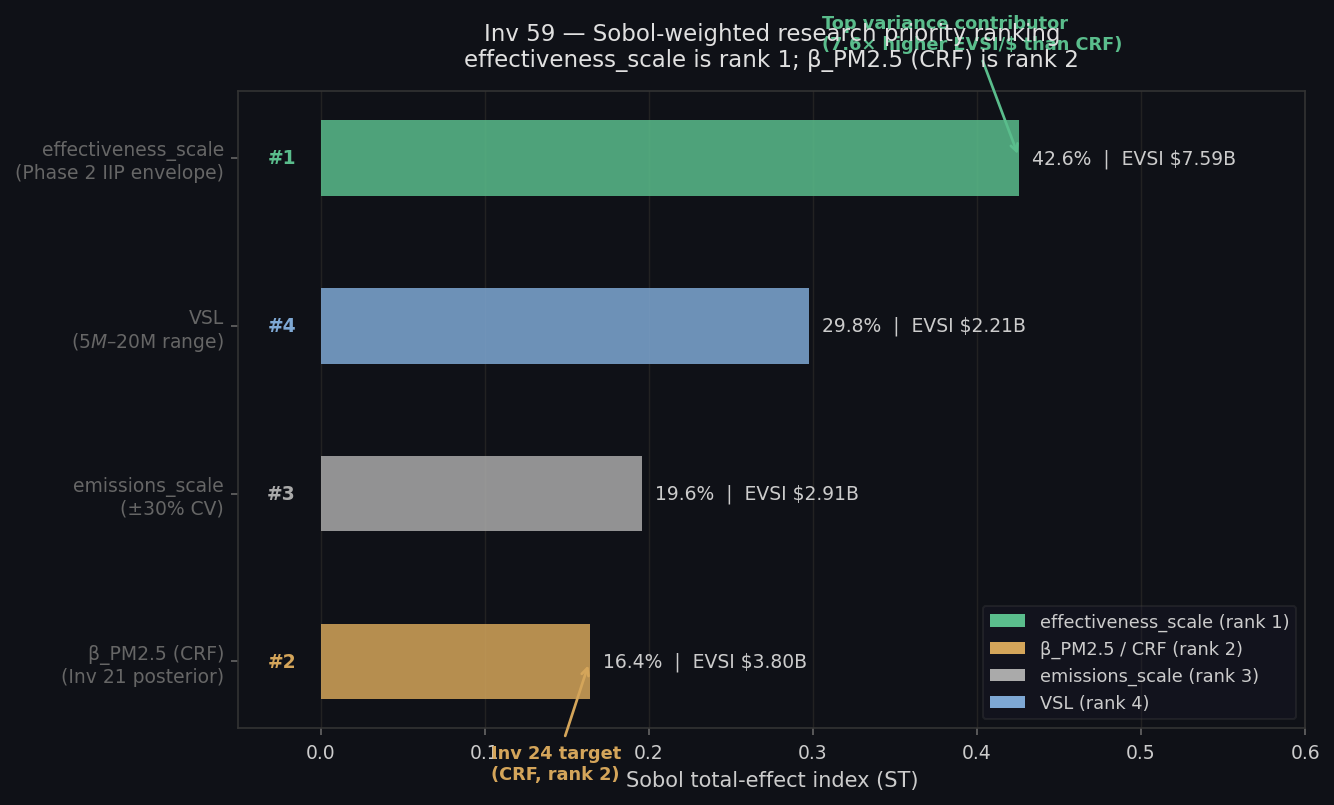
The health-risk research recommendation is still strongly positive — it’s just no longer first in line
The Sobol-weighted analysis confirms βPM2.5 CRF research at $3.80B adjusted EVSI at $2.5M cost (ROI 1,519×): strongly positive. Investigation 6-5’s recommendation is defensible and should still appear in the CEC proposal research narrative. This is not a demotion—it is a reranking. Effectiveness_scale has 7.6× higher adjusted EVSI per research dollar.
Sobol-weighted $5M budget: 46% to effectiveness_scale, 23% to CRF
Under proportional allocation of a $5M total research budget: effectiveness_scale receives $2.31M, emissions_scale $0.88M, VSL $0.67M, and βPM2.5 $1.14M. The CRF-first framing of Investigation 6-5 would have allocated the majority to βPM2.5; the Sobol-informed allocation redirects that majority toward effectiveness_scale.
Ozone-channel research quantifies a harm, not a benefit — that changes its priority
Investigation 4-1 shows P(net ozone benefit) = 0.0005 and NOx reduction fraction as the top driver (ST 35.8%). Research to tighten βO3 or NOx-cut uncertainty would quantify the magnitude of a harm, not unlock a benefit. Ozone-channel research is about damage mitigation design, not value discovery.
Effectiveness_scale: the study design
What is effectiveness_scale? It is the multiplicative factor (±30% CV in the the cascade's uncertainty model) capturing how closely realized electrification technology deployments match their assumed emission-reduction performance. A program with high effectiveness_scale uncertainty has large spread in deaths avoided per dollar of investment—not because of CRF uncertainty, but because the interventions themselves perform variably in the field.
Suggested study design ($3M, 2–3 yr). Retrospective CARB Incentive Investment Plan (IIP) sector evaluation: before/after emissions measurement for 2020–2025 IIP deployment cycles, per sector. References: CARB IIP annual reports (2020–2025); De Gouw et al. 2020 (CA mobile source emissions trends); CARB EMFAC 2021 documentation. The irreducible 40% reflects genuine physics uncertainty: marginal vs average emission effects, fuel switching timing, economic baseline variation.
Caveats
- Proportionality is an approximation. EVSI(driver) ∝ ST(driver) is the simplest defensible generalization of the Investigation 6-5 anchor. True EVSI depends on the decision boundary curvature, which is not computed for non-CRF drivers. A full Inv-24-style roadmap for effectiveness_scale would be the rigorous follow-on.
- Reducibility fractions are analyst-specified. The values (effectiveness_scale 60%, emissions_scale 50%, VSL 25%, βPM2.5 78%) are informed by study-design literature but carry ±15 percentage-point subjective uncertainty. Ranking is qualitatively stable at these ranges: effectiveness_scale still leads even at 40% reducibility.
- VSL is partly a governance choice. The $5M–$20M envelope spans institutional positions. Adopting EPA guidance eliminates ~50% of VSL spread at zero research cost; the “research cost” for VSL is a lower bound.
- One-period framework. Investigation 6-5’s sequential Bayesian model (staged pathway, adaptive stopping) is not replicated here for the other drivers. A proper multi-driver research portfolio would need a joint Bayesian experimental design.
- Effectiveness_scale data access uncertain. CARB IIP data may require sharing agreements. $3M estimate assumes data access; a proxy study costs more per unit of variance reduction.
Provenance
| Item | SHA-256 (12-char) | |
|---|---|---|
| results.json | 90b35f982716 |
|
| analysis.md | — | |
| scenario.md | — | |
| Upstream: Investigation 3-10 (Sobol indices) | investigations/55_cascade-sobol-gsa/latest/results.json | 1ac44c301ef3 |
| Upstream: Investigation 6-5 (CRF EVSI anchor) | investigations/24_crf-roadmap/latest/results.json | 9d0d51e92c1b |
| Upstream: Investigation 4-1 (ozone channel context) | investigations/49_ozone-channel-sobol/latest/results.json | 6900249d274c |
| Key reference | Strong et al. 2014 (EVPPI via GAM regression) — foundational EVSI method applied in Investigation 6-2/24. | |
| Run timestamp | 2026-05-04T16:54:23 Synthesis only (no new MC) | |