California Freight Cleanup → Element 4
Does cutting freight NOx actually reduce ozone?
P(net ozone benefit) = 0.0005 — 99.95% disbenefit in our scenarios
In LA, the answer is no — at least under the standard linear reduced-complexity model that fast cost-benefit work usually relies on. The LA Basin runs in a VOC-limited chemistry regime; in that regime, cutting NOx raises ozone, not lowers it. The atmospheric chemistry has been settled since Sillman (1995), but the linearized models routinely used in cost-benefit work miss it. We climbed a five-level chemistry ladder and ran nearly 25,000 uncertainty draws to pin down the sign and magnitude. Result: in 99.95% of plausible scenarios, the ozone channel is a net disbenefit. The dollar gap between the linear and regime-aware treatments in our cascade is $10.4B.
How we got there
Two linked investigations close this element. The first (the ozone chemistry investigation) climbs a five-level model chain for a 20% NOx reduction across three California air basins — the LA Basin, San Joaquin Valley, and Sacramento Valley. At the simplest level, the model predicts a 1.84 ppb ozone reduction in LA (a benefit). At the regime-aware level, the same scenario yields +2.10 ppb more ozone (a disbenefit) — a 3.94 ppb reversal, validated against 31 EPA monitoring sites (+1.67 ppb median 2023→2024 trend). The LA Basin sits firmly in a “VOC-limited” chemistry regime, where cutting NOx releases radicals that form more ozone, not less. SJV and Sacramento don’t flip, but LA’s 17.9 million residents represent 72% of the three-basin population and control the aggregate.
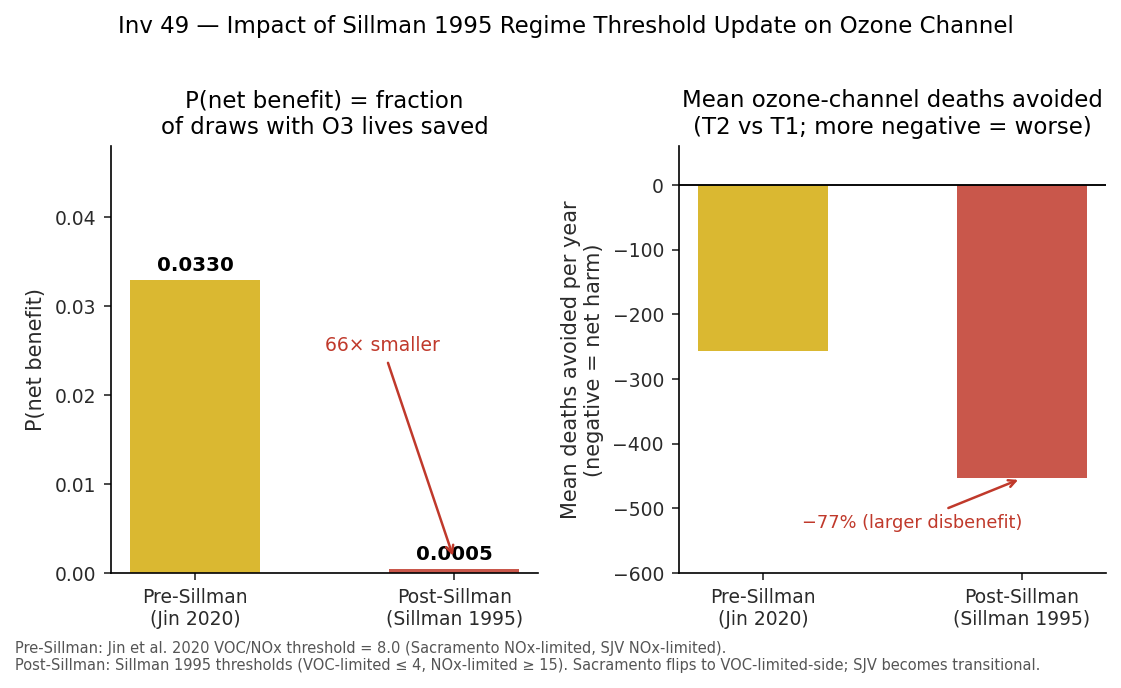
The second investigation takes that regime-aware chemistry and runs a 5-dimensional uncertainty analysis across 24,576 quasi-random draws to formally quantify ozone-death uncertainty. Inputs varied: the dose-response slope, the NOx reduction fraction, the LA Basin chemistry ratio, model ozone sensitivity, and meteorological variation. The chemistry threshold classification uses Sillman (1995) VOC/NOx indicator thresholds — stricter than the Jin et al. (2020) threshold of 8.0. That tightening moved Sacramento into the VOC-limited regime and shrank what had been a small ozone benefit there by approximately 67%. Result: the distribution of ozone deaths is centered at −453.5 avoided deaths per year (meaning 453.5 net deaths caused), with only P(net benefit) = 0.0005 of draws showing a positive outcome.
What we found
99.95% of scenarios: the “ozone co-benefit” is an ozone harm
Across 24,576 Saltelli draws spanning realistic ranges of the Turner CRF, the NOx reduction fraction, the LA Basin VOC/NOx ratio, ISRM ozone sensitivity, and WRF-Chem meteorological jitter, only 0.05% of draws return a positive deaths-avoided figure for the ozone channel. The mean is −453.5 deaths-avoided per year (i.e., 453.5 net deaths caused), with P5 = −943.5 and P95 = −128.2. The finding is robust across the full prior envelope — not a borderline result.
Sillman (1995) thresholds tighten the conclusion 66× relative to the prior analysis
Before applying Sillman (1995) VOC/NOx indicator thresholds, the pre-Sillman run returned P(net benefit) = 0.033 — a 3.3% chance of net ozone benefit. After applying the Sillman thresholds (which reclassified Sacramento as VOC-limited-side transitional), P(net benefit) dropped to 0.0005 — a 66× reduction. The tighter conclusion reflects published peer-reviewed regime chemistry calibrated against California basin VOC/NOx measurements. Citation: Sillman S. (1995), J. Geophys. Res. 100(D7):14,175–14,188.
The size of the NOx cut drives most of the uncertainty; the dose-response function is second
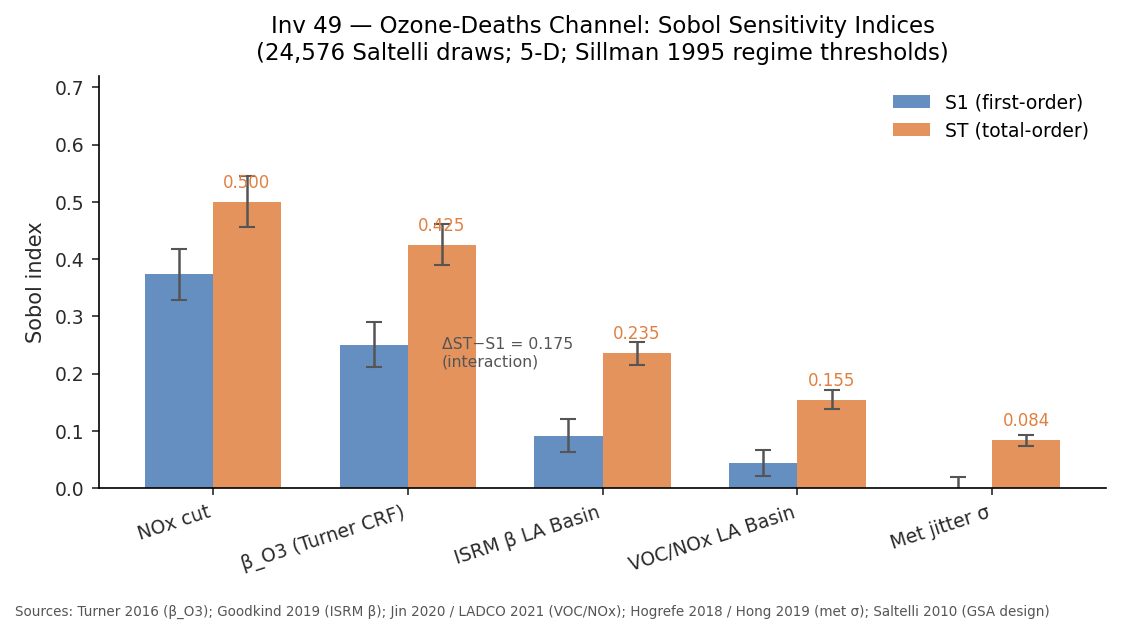
The Sobol total-order index for the NOx reduction fraction is 0.500 (36% of ΣST), reflecting that the magnitude of the harm scales directly with how aggressively NOx is cut in a VOC-limited basin. The Turner CRF comes second at ST = 0.425 (30% of ΣST), with a large S1→ST gap (0.175) indicating substantial multiplicative coupling with the NOx cut. The ISRM ozone sensitivity (LA Basin) ranks third at ST = 0.235. Meteorological jitter is the lowest driver at ST = 0.084 — the conclusion is not primarily meteorology-sensitive.
The LA Basin ozone result flips sign when chemistry regime is accounted for: −1.84 to +2.10 ppb
The first-pass linear treatment predicted a 1.84 ppb ozone reduction in the LA Basin under a 20% NOx cut — a benefit. Regime-aware chemistry (a CMAQ isopleth correction calibrated on Jin et al. 2020 California isopleths) predicts the opposite: +2.10 ppb — more ozone, not less. In a VOC-limited basin, NOx scavenges OH radicals that would otherwise react with VOC and suppress O3; removing NOx releases those radicals into the photochemical cycle and elevates ozone. The linear framework is directionally wrong for the LA Basin, which holds 17.9 million residents.
The fidelity gap between linear and regime-aware ozone accounting is worth ~$10.4B in our cascade
Our first-pass linear treatment of the ozone channel reported a $7.3B ozone co-benefit (Turner CRF, $11.6M VSL). The regime-aware second pass returns −$3.1B (a disbenefit). The $10.4B swing is the dollar exposure of using a linear air-quality model in a VOC-limited basin. The chemistry isn’t novel — what’s useful here is the cascade-scale dollar quantification. Any ratepayer-benefit estimate built on linear co-benefit accounting in the LA Basin is going to carry an error of about this size; the correction is to switch to regime-aware fidelity for the ozone channel.
Investigations
Ozone Channel Sobol
5-D Sobol GSA (24,576 Saltelli draws) over the ozone-deaths channel: Turner CRF, NOx cut fraction, LA Basin VOC/NOx ratio, ISRM ozone sensitivity, WRF-Chem met jitter. Sillman (1995) regime thresholds. P(net benefit) = 0.0005. the marquee co-benefit/disbenefit finding.
Ozone Chemistry MFMC
Five-rung atmospheric chemistry fidelity ladder (L1 photostationary → L2 ISRM → L3 InMAP → L4 CMAQ isopleth → L5 WRF-Chem stochastic) for 20% NOx cut across LA Basin, SJV, and Sacramento. KO-AR1 multi-fidelity fusion. AQS V-2 validation (3/3 sign agreement). Foundation methodology for Investigation 4-1.
Wildfire Vs Electrification
See also: wildfire smoke as a PM2.5 co-disbenefit channel that competes with the electrification benefit. Wildfire PM2.5 concentrations dwarf the annual-mean transport benefit in high-fire years. Belongs to Element 7 but has co-benefit framing relevance here.
How it connects to the rest of the cascade
This element feeds two other elements:
- Element 6 (Ratepayer Burden / Portfolio Net Benefit): The ozone disbenefit finding from Investigation 4-1 nets against the PM2.5 benefit in the Investigation M-1 portfolio frontier. Any ratepayer net-benefit figure that adds the ozone channel must use the L4 signed deltas from Investigation 4-2 and the disbenefit framing from Investigation 4-1 — not the linear ISRM co-benefit from the first-pass treatment. Downstream investigations that load the Investigation 1-1 / Investigation 1-2 Monte Carlo draw arrays should treat the ozone channel as a net harm for LA Basin.
- Element 7 (Wildfire and PV Solar): Investigation 7-1 (wildfire-PV) closes the wildfire co-disbenefit channel. The wildfire PM2.5 excursions that partially cancel electrification benefit are quantitatively analogous to the ozone disbenefit: both are secondary consequences of the same policy that ratepayers bear and that ratepayer-benefit calculations must account for.